


One Activation, Three Cities: How We Scaled Salesforce’s AI Trading Cards Across the Agentforce World Tours.
July 15, 2026
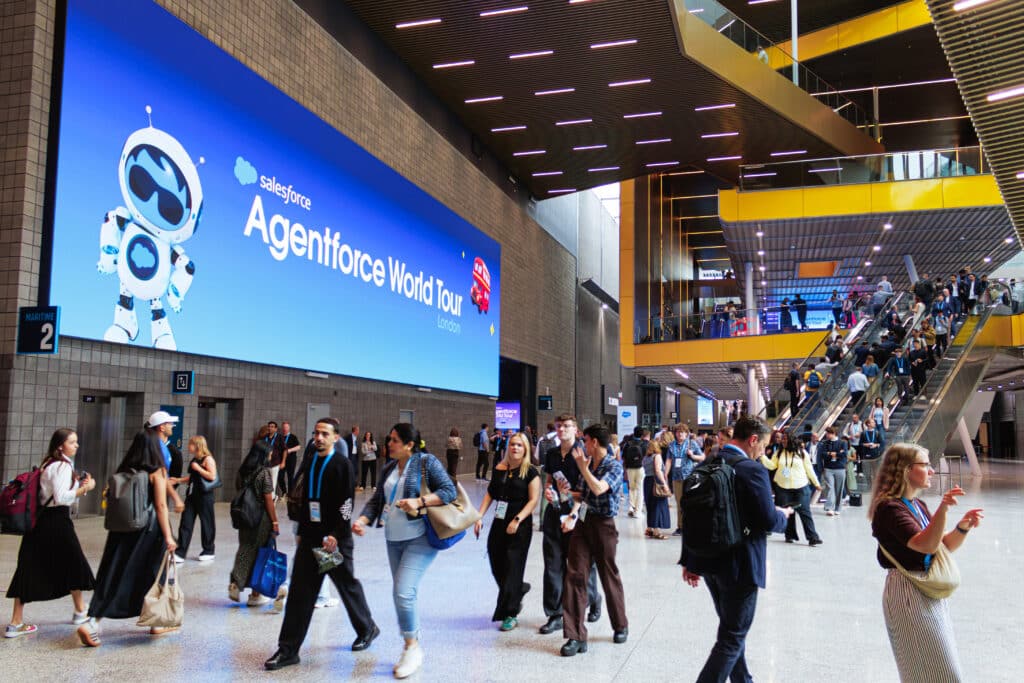
Salesforce runs its World Tour as a global series, bringing its platform community together city by city. Each stop draws a different crowd, in a different market, with its own local character.
For the 2026 run, Salesforce needed a brand moment that stayed consistent from one city to the next while still feeling native to each room. They came to Pop Life Photo to carry a single activation across three markets on three continents: New York, London, and São Paulo.
The activation was our AI Trading Card experience, the same format Salesforce has run at flagship events like Salesforce TDX 2026 and Dreamforce. This time the assignment was different. One system, three cities, no loss of brand cohesion.
What the Salesforce World Tour Is
The World Tour is Salesforce’s traveling event series. It moves through major cities around the world, from New York and London to São Paulo, Tokyo, and Sydney.
Each stop gives attendees a chance to learn from industry experts, see real customer use cases, and get hands-on with the Salesforce platform. The audience shifts from city to city, but the brand has to feel like one continuous experience across the entire tour.
That is the exact problem a repeatable activation is built to solve.
The Challenge
A brand moment that travels is harder than it sounds. A common problem among brands expanding into international markets is striking the balance between consistency while also adapting to cultural differences or local competitors. Push too far toward consistency and every city feels like a copy-paste. Lean too far into local flavor and the brand starts to fragment.
Salesforce wanted both at once. A recognizable experience that any attendee in any city would instantly connect to the Salesforce brand, and a version of that experience that was made for that event only.
The tension between those two goals is where most touring activations break down. The answer is not to compromise between them, but to build one system strong enough to carry the brand and flexible enough to localize on top of it.
There was a second constraint. São Paulo had restrictions because we could not be physically present, so the usual physical build was not an option there.
That meant the format had to prove something. It had to hold up even when we stripped away the physical footprint entirely.
The Activation
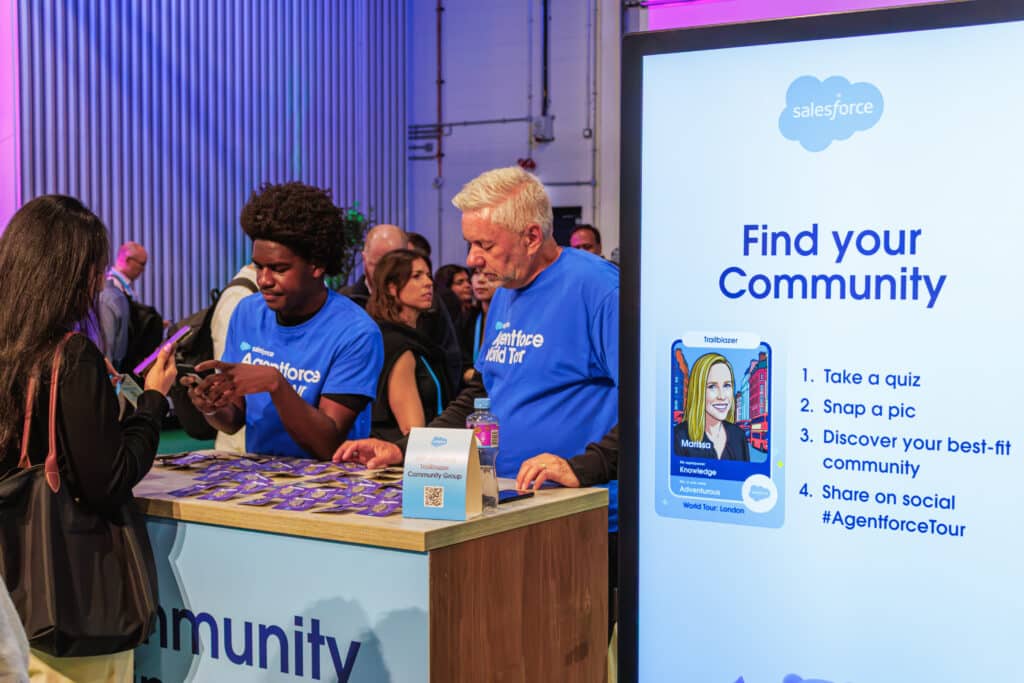
The AI Trading Card turns each guest into a collectible card built around their place in the Salesforce community. It is part quiz, part portrait, part keepsake.
A guest answers a short Salesforce quiz that identifies their community, then adds a few personal inputs like their name and one word to describe themselves. They step up to a station, and their photo and answers combine into a custom card in seconds.
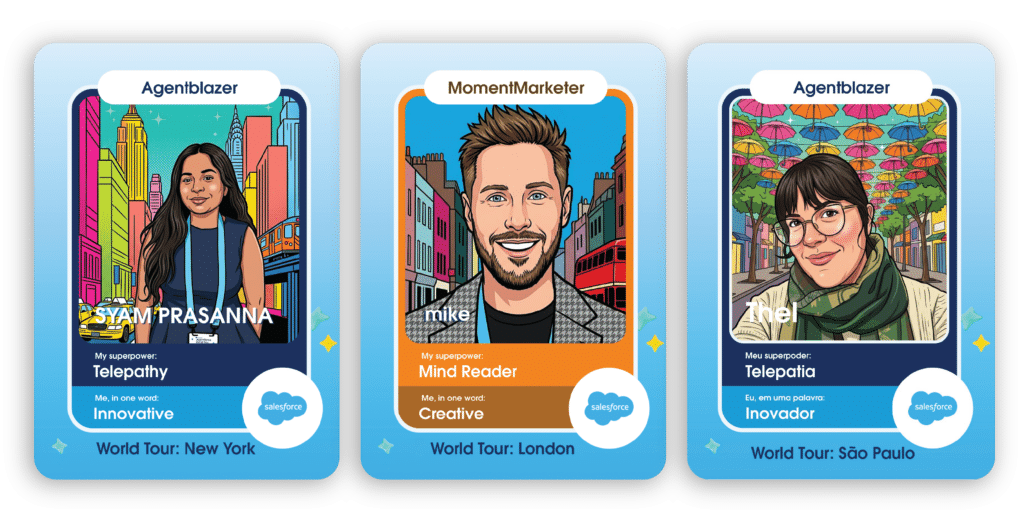
The front carries an AI-styled portrait, their name, community icons, and their Salesforce community. The back adds a longer description of that community.
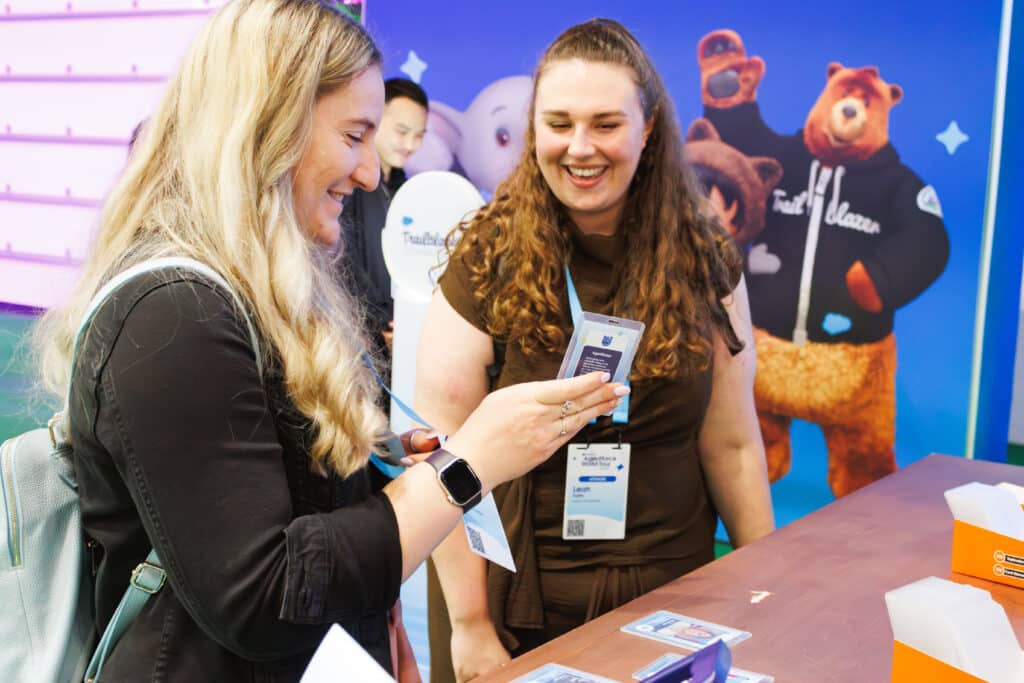
Every guest walks away with a digital card they download by QR code and printed cards in a sleeve they can wear as a badge. We first ran this format at Dreamforce 2025. The World Tour was about proving it could travel.
One System, Flexed to Three Markets
The part that made this work was the system underneath. One unified build, adapted rather than rebuilt for each city.
City-specific icons and backgrounds did most of the localizing. Each market got visual cues that felt native to its audience, while the core brand system stayed intact across all three stops.
New York ran as a full physical activation. London did the same, with its own set of local design touches layered on top of the shared system.
São Paulo was the proof point. We built a virtual-only version that guests completed from their own phones, capturing engagement with no physical footprint at all.
That last one matters more than it first appears. It showed the format holds up in any configuration, from a full-footprint build to a screen in someone’s hand.
Why This Format Works
The AI Trading Card is not a one-time set piece. It is a system built to repeat, and that changes what it can do for a brand.
It adapts. You take the same activation and tailor it to a new audience without starting from scratch each time. The operation stays the same while the output feels fresh.
It is collectible. Because each event can introduce new versions, guests collect cards over time instead of experiencing a brand-new activation at every stop. Same format, same operation, reinvented for each room.
It generates leads with continuity. The same software collects opt-in data from event to event, so a brand can watch response build across a full tour and compare what lands from city to city. That kind of continuous, comparable data is rare in event marketing.
It works physical or virtual. When floor space is tight, a virtual build lets guests take part from any personal device. The activation adapts to the space instead of forcing the space to adapt to it.
It scales. The same experience runs for a hundred guests or several thousand, using more stations or a virtual option to match attendance.
For agencies and enterprise teams running a series of events, that combination is the real value. One activation you can carry across an entire calendar, collecting comparable data the whole way.
It also gives a brand a reason to come back to the same format instead of chasing a new idea every quarter. When guests collect cards across a tour and the data gets richer with each stop, the activation becomes more valuable the longer it runs, not less. That is a rare thing in event marketing, where most activations peak once and then need replacing.
What We Learned
The biggest takeaway was how much design carries the experience. Not just the look of the final card, but every layer of how a guest moves through it.
Guest flow design is an integral part of the experience. How someone moves from the Salesforce quiz to the capture station to their finished card decides whether the experience feels effortless or confusing. Get the flow right and guests never have to think about the mechanics.
Visual design is where the brand lives. The polish of the output, the personalization through icons and community graphics, the portrait styles, the colors, all of it determines whether a card feels like another copy and paste template versus a custom item worth keeping.
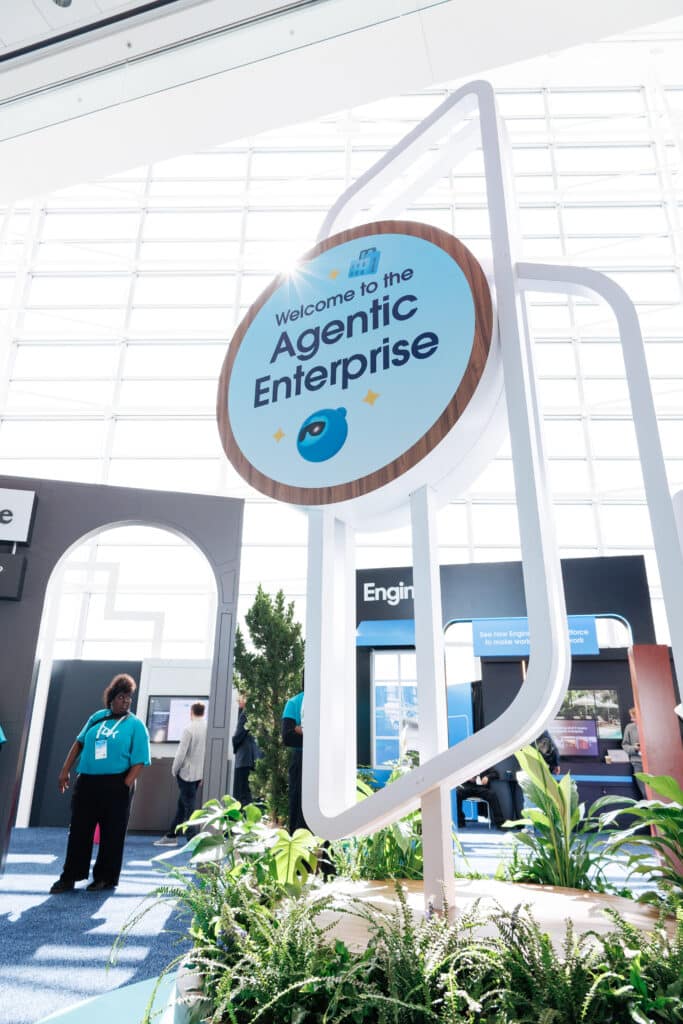
Environmental design sets the tone. The space a guest walks into, the signage, the backdrops, the furnishings, all of it signals whether they are arriving somewhere worth their time before they ever pick up a card.
When those three layers line up, guests feel like they have arrived at a destination, not walked up to a table. That feeling is what gets a card shared and worn instead of pocketed and forgotten.
The Results
Across the three stops, the activation drove more than 3,280 combined sessions.
New York brought 1,365 sessions. London brought 1,653 sessions, along with 882 shares and 557 downloads.
São Paulo, running entirely virtual, added 262 sessions, 100 shares, and 51 downloads from zero physical footprint.
The São Paulo numbers are worth sitting with. A virtual-only build still captured hundreds of sessions and real sharing activity, which is the clearest evidence that the format does not depend on a physical stage to perform.
Taken together, the three stops show what a well-built activation can do. One system held its shape across three continents, adapted to each audience, and delivered measurable engagement in every configuration we ran it in.
Bring This to Your Next Event
If you are planning an event series and want one brand moment that travels with you, the AI Trading Card is built for exactly that. It scales across cities, adapts to physical or virtual spaces, and gives you data you can actually compare from stop to stop.
Browse more of our work on our case studies page, read more about the AI Trading Card activation, or start a conversation about your upcoming events.